
Early childhood is the most important stage of a child’s growth. During these first years, children learn how to think, communicate, manage emotions, and connect with others. For Early Childhood Development (ECD) professionals, one of the most powerful and enjoyable tools to support this growth is storytelling.
Storytelling is more than simply reading a book aloud. It is an active learning experience that shapes children’s cognitive, linguistic, and social-emotional development. When ECD educators use storytelling well, they help children build skills that support success throughout school and life.
Storytelling turns everyday classrooms into places of wonder, where young minds learn to think, feel, and express with confidence.
This article explains why storytelling matters, how it benefits young children, and why ECD training is essential to help educators use storytelling effectively. It also includes examples, tips, and research that can guide early childhood professionals in daily practice.
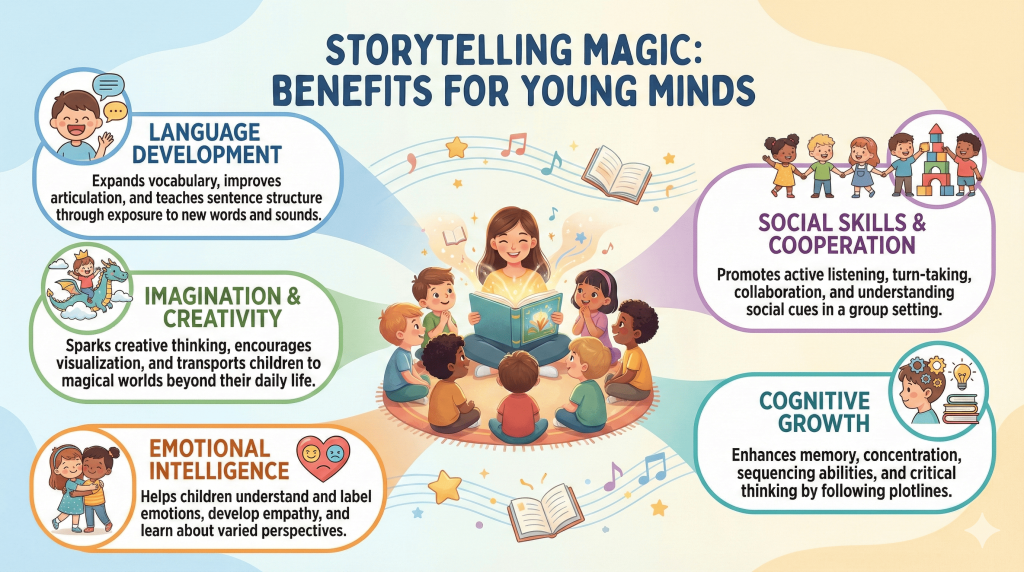
Why Storytelling Matters in Early Childhood Development
A Natural Way of Learning
From ancient times to the present, people everywhere have learned through stories. Young children especially enjoy stories because they include imagination, surprise, repetition, and emotion. Storytelling fits naturally into early childhood settings, making learning feel safe and engaging.
For ECD educators, storytelling is one of the simplest ways to support brain development. It builds connections between ideas, encourages attention, and strengthens relationships in the classroom.
Cognitive Benefits of Storytelling
1. Stronger Memory and Attention
Stories help children remember events, characters, places, and actions. When children listen to a story repeatedly, they begin to recall details and anticipate what comes next. This improves memory and concentration – two key skills needed for learning later in school.
Research has shown that storytelling activities help children build sequencing skills (understanding beginning, middle, and end), which supports reading comprehension and logical thinking.
2. Better Problem-Solving and Critical Thinking
Most stories include a challenge:
A character becomes lost, faces a fear, or needs to make a choice.
As children follow the story, they try to guess what might happen or suggest solutions. This strengthens critical thinking and helps them learn how to evaluate situations.
For example:
If a story character cannot find their way home, an educator might pause and ask,
“What do you think the character should do next?”
By offering ideas, children practise reasoning and decision-making – both important parts of cognitive development.
3. Boosting Imagination and Creativity
Storytelling encourages children to imagine places they have never seen – a magical forest, a deep ocean, a busy city, or even outer space. When this happens, their creativity grows naturally.
Young children may:
- Create their own stories
- Change the ending of a familiar tale
- Draw pictures related to the story
- Act out scenes using their bodies and voices
This creative play helps develop flexible thinking and emotional expression.
Linguistic Benefits of Storytelling
1. Rich Vocabulary Growth
When educators tell stories, they use words children may not hear in daily conversation. The story gives these new words meaning, helping children understand and use them later.
For example:
- “enormous” instead of big
- “discovered” instead of found
- “frightened” instead of scared
Hearing and repeating these words in context supports early literacy development.
2. Improved Listening and Understanding
Storytelling helps children practise listening. They learn to:
- Follow a sequence
- Understand cause and effect
- Predict what comes next
- Ask and answer questions
These skills support reading comprehension and future academic success.
Studies on early literacy show that children who regularly listen to stories develop stronger comprehension skills and perform better in later reading tasks.
3. Early Reading and Writing Skills
Storytelling helps children understand how stories “work.” They learn basic narrative structure:
- A beginning that introduces characters
- A middle with a problem
- An ending that solves the problem
By retelling stories, drawing story events, or acting out scenes, children begin developing pre-writing and pre-reading abilities. Many early childhood programs now use “story dictation,” where children create a story, and an educator writes it down. This bridges oral language and written literacy.
Digital storytelling is also becoming popular. When children use simple technology – such as selecting pictures and recording their voice – they build confidence with both language and digital tools.
Socio-Emotional Benefits of Storytelling
1. Building Empathy and Understanding of Emotions
Stories allow children to experience the feelings of others. When a character feels sad, excited, angry, or scared, children learn to recognize and label those emotions.
Storytelling is one of the best ways to support emotional development because it:
- Helps children understand their own feelings
- Teaches them how others may feel differently
- Encourages compassion and kindness
Many ECD educators use stories to talk about behavior, friendships, and problem-solving in social situations.
2. Stronger Social Skills
Storytelling often involves group participation. Children listen, respond, and interact with the educator and each other. This helps them learn:
- Turn-taking
- Respectful listening
- Sharing ideas
- Cooperative play
Group storytelling activities also help shy children participate more comfortably.
3. Supporting Emotional Regulation
Some stories show characters handling difficult situations – dealing with fear, calming down, or finding help. Educators can use these stories to teach children how to:
- Name their feelings
- Use coping strategies
- Wait patiently
- Express themselves safely
Children learn emotional skills more easily when they see characters model them.
How ECD Training Supports Effective Storytelling
ECD training plays a major role in helping educators use storytelling with confidence and purpose. Without proper training, storytelling may become a simple entertainment activity rather than a tool for development.
Here are the reasons ECD training is important:
1. Helps Educators Learn the Right Techniques
In training programs, educators learn how to:
- Use voice modulation
- Change pace and tone
- Hold young children’s attention
- Encourage participation
- Use age-appropriate story structures
These skills make storytelling more engaging and effective.
2. Supports Curriculum Planning
With training, educators can connect storytelling to:
- Language goals
- Social-emotional learning
- Creative arts
- Cognitive skills
- Motor development (through acting or movement)
This ensures storytelling is purposeful, not random.
3. Encourages Inclusive and Diverse Story Choices
ECD training helps educators select stories that:
- Reflect many cultures
- Include different family structures
- Respect all genders
- Include children with disabilities
- Show meaningful values and life experiences
This promotes an inclusive learning environment.
4. Teaches Educators How to Use Props and Visual Tools
Training introduces tools like:
- Puppets
- Storyboards
- Felt boards
- Picture cards
- Simple costumes
- Real-life objects
These make stories more concrete and help children understand abstract ideas.
5. Prepares Educators for Digital Storytelling
Modern ECD training often includes digital skills, such as:
- Creating simple story videos
- Using audio recordings
- Using interactive story apps
- Supporting children in digital storytelling
Digital storytelling is especially effective for visual learners.
Practical Storytelling Tips for ECD Educators
Here are simple, classroom-ready ideas to help educators use storytelling daily.
1. Use Daily Story Moments
Set a regular storytelling time. Even 5–10 minutes each day helps.
2. Use Props to Make the Story Come Alive
Try:
- Puppets
- Simple hats
- Stickers
- Flashcards
- Household items (a spoon can be a magic wand!)
Children stay engaged when they can “see” the story.
3. Encourage Children to Join In
Ask questions like:
- “What do you think will happen next?”
- “How do you think the character feels?”
- “Can you show me with your face?”
This supports cognitive and emotional development.
4. Repeat Stories Often
Young children learn through repetition. Telling the same story many times helps them predict, remember, and retell.
5. Use Stories from Many Cultures
Families love sharing stories from home. Invite them to bring a traditional tale or record a story in their language.
6. Try Simple Digital Storytelling
Use a phone or tablet to:
- Record children narrating
- Make a slideshow of pictures
- Add simple sound effects
Children get excited knowing they helped create the story.
Examples of Storytelling in Real ECD Settings
Example 1: Problem-Solving Story Circle
A teacher tells a story about a rabbit who loses its way. She pauses and asks:
“What should the rabbit do?”
Children offer ideas, act them out, and continue the story together.
Example 2: Cultural Story Sharing Day
Families bring stories from their own culture. Children listen to tales from Nepal, India, China, or Africa, then draw their favorite scenes.
Example 3: Digital Story Project
Children choose animal pictures and tell their own “jungle adventure” story. The educator records their voice and plays it back later. Children feel proud because it is their story.
Why Storytelling Should Be a Priority for ECD Educators
ECD educators play a central role in shaping early development, and storytelling helps achieve learning goals across all domains. Here’s why educators should care:
- It strengthens early language and literacy
- It helps children manage emotions
- It develops imagination and creativity
- It builds social confidence
- It supports inclusive classroom environments
- It creates joyful learning moments
Most importantly, storytelling helps educators build warm, responsive relationships with children – something essential for healthy early childhood development.
When children hear stories, they don’t just listen — they build worlds, strengthen language, and grow their imagination.
Final Words
Storytelling is one of the most powerful tools in early childhood development. It supports cognitive growth, language learning, and social-emotional skills in simple and enjoyable ways. With the right ECD training, educators can transform storytelling into a strong teaching strategy that helps children learn, express, and connect.
For ECD professionals, investing time and effort into storytelling is a long-term investment in children’s success. Each story, each conversation, and each shared moment helps shape a child’s confidence, curiosity, and love for learning.
