
Social-emotional development is a key part of every child’s early growth. It shapes how children understand their feelings, express their needs, make friends, and solve problems. In early childhood education, teachers and caregivers spend many hours with young children. Because of this, they play a major role in guiding children’s emotions and behaviour.
Many teachers feel unsure about how to support children who cry often, get angry easily, or struggle to join play. This is why ECD training is so important. ECD training gives teachers practical tools, simple strategies, and research-based methods that help them support children in a positive way.
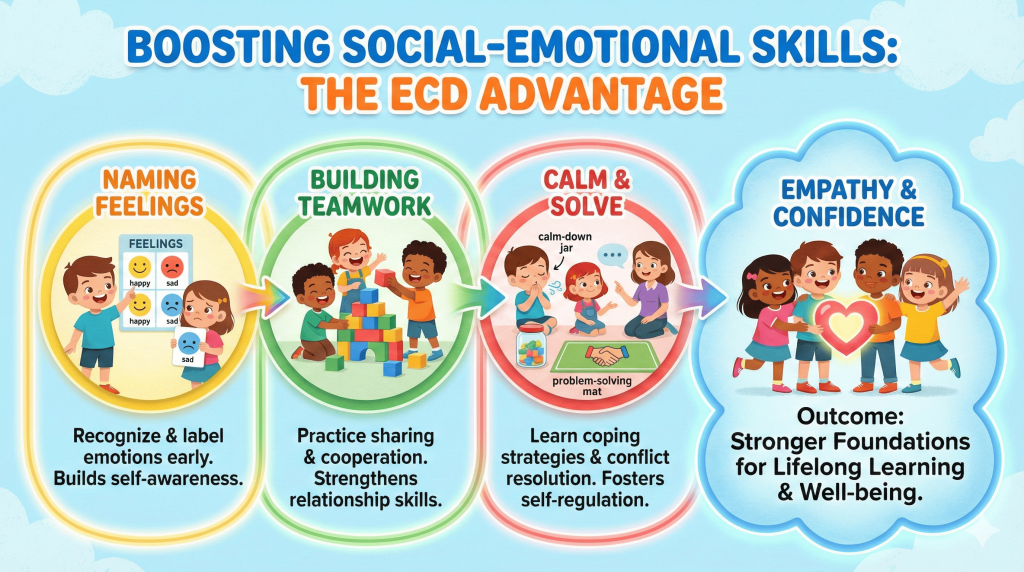
This article explains the importance of social-emotional development, the role of ECD training, classroom strategies, and realistic examples ECD professionals can use every day.
What Is Social-Emotional Development?
Social-emotional development includes skills such as:
- understanding feelings
- expressing emotions in healthy ways
- building relationships
- cooperating with others
- showing empathy
- solving problems
These skills grow slowly through everyday experiences at home, school, and in the community.
Common Milestones (Ages 0–6)
Ages 0–2
- Recognizing familiar people
- Responding to smiles and voices
- Showing basic feelings
- Playing next to other children
Ages 3–4
- Naming feelings
- Playing with peers
- Taking turns
- Showing empathy
Ages 5–6
- Solving simple conflicts
- Following rules
- Working in groups
- Listening and communicating
These milestones connect closely with daily experiences in early childhood education settings.
Why Social-Emotional Development Matters
Research from UNICEF (2023) shows that children who develop strong emotional skills early are more likely to:
- succeed in school
- enjoy strong mental health
- communicate clearly
- build healthy friendships
- make good decisions later in life
Social-emotional skills predict long-term success just as much as academic skills.
How ECD Training Supports Social-Emotional Development
ECD training helps teachers understand child behavior and gives them step-by-step methods to support children’s growth.
What Teachers Learn in ECD Training
1. Emotion Coaching
Teachers learn how to help children name their feelings and understand what those feelings mean.
2. Positive Behaviour Guidance
Instead of punishment, teachers use routines, visual schedules, calm communication, and redirection.
3. Building Warm Relationships
Children learn best when they feel safe. Training teaches teachers how to greet children, listen to them, and build trust.
4. Creating the Right Environment
Teachers learn how to design spaces that help children feel calm and ready to learn, including cosy corners and areas for group activities.
5. Supporting Many Types of Children
ECD training helps teachers support shy children, active children, children with big emotions, and children facing trauma or stress.
Popular ECD Training Approaches
- The Pyramid Model – focuses on social-emotional skills and behaviour support
- Responsive Classroom – focuses on positive teacher-child interactions
- Conscious Discipline – focuses on emotional safety and self-regulation
These programs are used globally and backed by research.
Real Classroom Examples
1. A Child Who Gets Angry Easily
Before training:
The teacher says, “Calm down,” but the behaviour repeats.
After training:
The teacher follows steps like:
- “You look angry.”
- “Would you like the calm corner?”
- Teaches breathing or counting
This supports emotional learning, not just control.
2. A Shy Child Who Avoids Play
Before training:
The child stays alone.
After training:
The teacher guides them gently:
- Playing beside them
- Pairing them with a friendly peer
- Offering small-group activities
The child becomes more confident.
3. Children Fighting Over a Toy
Before training:
The teacher separates them.
After training:
The teacher teaches problem-solving:
- “What happened?”
- “What can we do?”
- “Let’s take turns.”
This builds communication and cooperation.
Benefits of Supporting Social-Emotional Development
1. Better Learning and Academic Growth
Children with stronger emotional skills:
- focus better
- follow routines
- try new activities
- participate more
2. Improved Behaviour
They learn:
- self-control
- sharing
- waiting
- using words instead of actions
3. Strong Friendships
Good social-emotional skills help children:
- cooperate
- understand others
- build lasting relationships
4. Better Mental Health
WHO (2023) reports that children who learn emotional regulation early have a lower risk of anxiety and depression.
5. Long-Term Life Success
These skills support adulthood:
- teamwork
- career success
- stable relationships
- responsible decision-making
Challenges in ECD Training
ECD training has challenges such as:
- limited access to workshops
- lack of funding
- long teacher hours
- difficulty applying new skills
- limited coaching support
Many early childhood professionals want training but cannot access it.
Solutions to Improve ECD Training
1. Online Learning Options
Online courses allow teachers to learn anytime with video examples and simple explanations.
2. Government Support
Funding, teacher qualification standards, and professional development policies help raise quality.
3. Coaching and Mentoring
Teachers learn faster when guided by experienced mentors.
4. Weekly School-Based Learning
Short weekly sessions help teachers practice new skills slowly and consistently.
5. Working with Families
Parents can support social-emotional development at home through routines, calm communication, and simple emotional games.
Practical Tips for Teachers and ECD Professionals
1. Use Feeling Cards
Children point to pictures to express emotions.
2. Teach Calm-Down Techniques
Breathing, stretching, counting, or sitting quietly for a moment.
3. Tell Social Stories
Short stories help children understand sharing, waiting, cleaning up, and asking for help.
4. Model Kind Language
Children learn by copying adults.
5. Create a Peace Table
A place where children can talk and solve conflicts together.
6. Keep Routines Clear
Predictable routines help children feel secure.
7. Praise Positive Behavior
Give specific praise, like:
“You helped your friend. That was kind.”
8. Encourage Cooperative Play
Use group puzzles, shared art activities, and simple team tasks.
Conclusion
Social-emotional development is a major part of early childhood education. These skills help children understand themselves, build friendships, communicate well, and handle challenges. Because early years shape the rest of a child’s life, teachers and caregivers must be trained and confident in supporting emotional growth.
ECD training gives teachers the knowledge, practical strategies, and confidence they need to guide young children in a positive and supportive way. When teachers are trained, children learn better, behave better, and feel more secure.
Investing in ECD training means investing in a strong emotional foundation for every child. With the right support, every child can grow into a confident, kind, and capable adult.
