
Many preschool teachers and caregivers notice how children become excited when they find a tiny insect, feel a leaf, or hear a bird call. These small moments create a natural interest in the world around them. Nature learning in the backyard gives children aged 0–8 a simple way to explore real-life science, develop curiosity, and build early problem-solving skills. A backyard, school garden, or small outdoor area can become a powerful learning space where children connect experiences with early concepts.
Nature learning in the backyard matters because early childhood is a period of rapid brain growth. During this stage, children learn best through hands-on play, direct sensory experiences, and active exploration. Research shows that outdoor environments support cognitive, social, and emotional development (Harvard Center on the Developing Child, 2022). Even a small space with soil, plants, stones, or water can help children develop observation skills, language, motor abilities, and environmental awareness. Teachers and caregivers can use these natural materials to introduce scientific thinking in simple, age-appropriate ways.
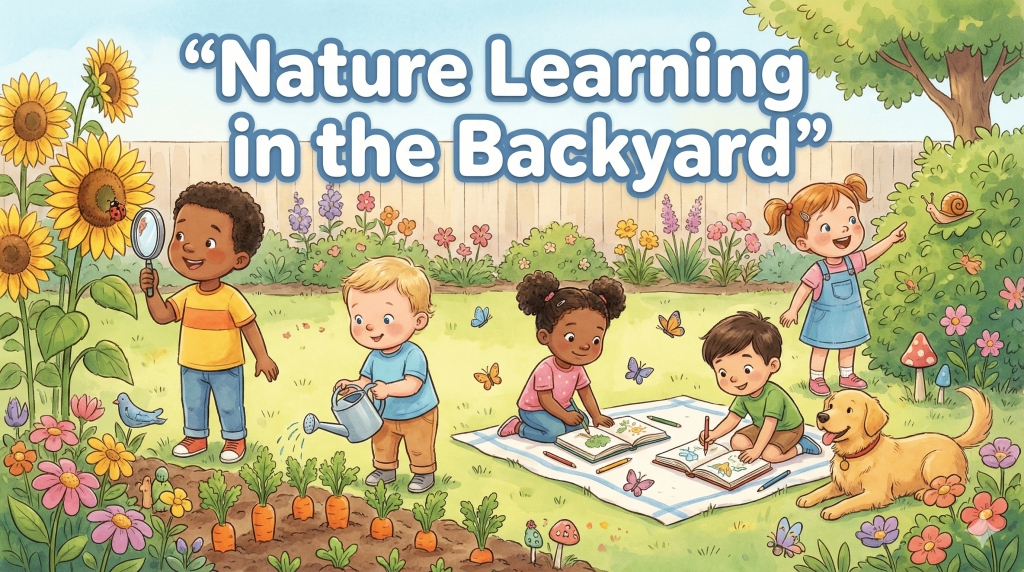
In daily classroom and caregiving routines, adding nature experiences can calm children, increase focus, and support healthy physical activity. Many preschool settings find that even short outdoor learning activities improve cooperation and communication among children. It is important to consider how everyday outdoor moments — such as watering plants, watching clouds, or collecting leaves — can become meaningful learning opportunities. The following sections offer practical, evidence-based strategies to support early childhood nature exploration in any backyard or outdoor space.
Creating a Safe and Inviting Backyard Learning Space
In many preschool classrooms, children gain confidence when the outdoor space feels safe and inviting. A well-prepared backyard area encourages children to explore freely while supporting their early development needs.
- Check the ground for sharp objects, slippery surfaces, or harmful plants before activities.
- Create clear play zones, such as a digging area, plant area, and quiet sitting space.
- Place simple natural materials like stones, sticks, leaves, or sand where children can reach them easily.
- Use child-sized tools for digging or watering to support independence.
According to Montessori principles, a prepared environment helps children explore at their own pace while building concentration and independence. When children move freely in a safe outdoor space, they strengthen motor skills and learn to manage small challenges. UNICEF (2021) highlights that safe outdoor environments improve children’s confidence and well-being. Transitioning to the next section, teachers and caregivers can use this safe space to introduce meaningful observation activities.
Supporting Observation Skills Through Simple Nature Discoveries
During early learning activities, children often demonstrate curiosity when they notice changes in nature. A backyard offers many opportunities for children to watch insects, observe plant growth, or explore patterns in stones, leaves, or tree bark.
- Try setting up a “nature observation corner” with magnifying glasses and containers for temporary viewing.
- Encourage children to look closely at shapes, patterns, colours, or textures.
- Ask open-ended questions, such as “What do you notice?” or “How does it feel?”
- Invite children to compare items, such as two leaves or two types of soil.
According to Piaget’s cognitive development theory, children in the preoperational stage (ages 2–7) learn by exploring objects and making early connections. Observation builds early scientific thinking and attention skills. Recent research shows that nature-based observation activities improve early focus and problem-solving abilities (Stanford Early Learning Study, 2020). As children expand their observation skills, they also begin to understand basic natural processes, which leads naturally into the next theme: learning about plants.
Introducing Children to Plant Life and Growth
In many preschool settings, children become excited when they see tiny sprouts or help water a young plant. Nature learning in the backyard provides direct experiences with how plants grow, change, and depend on the environment.
- Let children plant fast-growing seeds such as beans, coriander, or sunflower.
- Encourage children to water plants daily using small watering cans.
- Create a simple plant-growth chart with drawings or photos.
- Invite children to check soil moisture and talk about what plants need to survive.
Vygotsky’s theory emphasises the importance of guidance and shared learning. When teachers demonstrate planting steps and support children’s thinking through questions, children learn new vocabulary and concepts. Studies from the Royal Horticultural Society (2022) show that gardening activities increase children’s understanding of nature and support emotional well-being. Transitioning forward, this hands-on plant learning prepares children to explore living creatures in the backyard.
Exploring Insects and Small Creatures Respectfully
During outdoor learning activities, children often express interest in insects such as ants, butterflies, snails, or worms. These creatures help children learn about life cycles, movement, and habitats.
- Set up a “mini-beast safari” where children gently look for insects under stones or leaves.
- Provide small brushes or sticks to move objects instead of touching insects directly.
- Teach simple rules such as “Look gently, return gently.”
- Use picture cards to help identify insects and their basic features.
According to Reggio Emilia principles, children learn through relationships — including relationships with the natural world. Learning to care for living creatures supports empathy and social-emotional development. Research from the University of Exeter (2020) suggests that children who engage with small wildlife develop stronger environmental awareness. This growing curiosity leads naturally to sensory experiences, another essential element of early childhood nature exploration.
Encouraging Sensory Play with Natural Materials
Observation shows that children benefit from sensory activities such as touching soil, feeling grass, listening to birds, or smelling flowers. Nature learning in the backyard supports rich sensory play that helps children understand textures, temperatures, sounds, and scents.
- Create a sensory tray with soil, sand, leaves, stones, and water.
- Invite children to use their hands to mix, pour, or sort materials.
- Encourage listening walks where children identify natural sounds.
- Offer scented plants like mint or basil to support smell exploration.
Sensory play strengthens neural connections, supporting language, motor development, and self-regulation. Research indicates that outdoor sensory play reduces stress and improves attention (American Academy of Pediatrics, 2020). With sensory skills developing, children are ready to participate in more structured outdoor learning activities related to early numeracy and science.
Building Early Science and Maths Skills Outdoors
Backyard environments naturally support counting, comparing, sorting, and predicting outcomes. Early childhood nature exploration helps children practise early mathematics and scientific thinking without pressure.
- Invite children to count leaves, stones, or petals.
- Let children sort items by size, colour, or shape.
- Set up simple science experiments, such as watching how water moves through soil.
- Encourage children to predict which objects will float or sink in a water tub.
According to Piaget, young children make sense of the world by manipulating objects and observing results. Outdoor learning activities support the development of classification, measurement, and basic reasoning. Studies from the Australian Council for Educational Research (2021) confirm that nature-based maths tasks improve early numeracy understanding. These explorations also encourage creativity, which is essential for holistic development.
Supporting Creativity and Imagination Through Nature Play
In many early learning settings, children use natural materials to create imaginative stories, structures, and artworks. Nature learning in the backyard encourages creativity and open-ended play.
- Offer loose materials like sticks, stones, seeds, feathers, and shells.
- Invite children to create nature collages or simple sculptures.
- Encourage pretend play with leaves as “money” or sticks as “magic wands.”
- Provide space for children to build small houses or patterns using natural items.
Creativity aligns with Erikson’s stage of initiative, where children experiment with ideas and gain confidence. Research from the LEGO Foundation (2022) highlights that creative outdoor play supports flexible thinking and language development. After building imagination skills, children can extend their nature learning by participating in simple environmental care routines.
Teaching Responsibility Through Nature Care Routines
During daily routines, children often enjoy helping with small tasks such as watering plants or cleaning a play area. Nature learning in the backyard offers many chances to teach responsibility and care.
- Assign simple jobs, such as watering or collecting dry leaves.
- Encourage children to check if plants need sunlight or shade.
- Teach simple recycling habits using natural materials.
- Model gentle behaviour with plants and animals.
These routines support social-emotional development and help children learn cause-and-effect relationships. Studies show that environmental care tasks improve children’s empathy and sense of belonging (UNESCO, 2023). As children practise responsibility, teachers can introduce structured routines that support nature journaling and reflection.
Using Nature Journals to Build Language and Thinking
In many classrooms, children show interest in drawing what they see outdoors. Nature journals support language development, creativity, and early writing skills.
- Provide notebooks where children can draw plants, insects, or weather.
- Encourage children to describe what they saw during outdoor play.
- Use simple prompts such as “Today I noticed…” or “This leaf is…”
- Invite group sharing to build confidence and vocabulary.
Vygotsky highlights that language develops through social interaction. Journaling connects outdoor experiences with expressive communication. Research from the National Literacy Trust (2021) shows that nature-based storytelling improves vocabulary and comprehension. These simple practices help children create meaningful links between nature and learning.
Conclusion and Key Takeaways
Nature learning in the backyard offers rich opportunities for children aged 0–8 to explore, observe, question, and care for the environment. Outdoor learning activities help children develop early science, maths, language, motor skills, and emotional awareness. A small backyard or garden can support meaningful growth when teachers and caregivers provide simple, structured opportunities for discovery. Research continues to show that early childhood nature exploration improves focus, creativity, confidence, and overall well-being. With thoughtful planning and consistent routines, any outdoor space can become a valuable learning environment.
The following key actions can help strengthen outdoor learning experiences:
- Create a safe, inviting space that encourages exploration.
- Use observation activities to build early scientific skills.
- Introduce plant growth routines with simple tools.
- Teach respectful exploration of insects and small creatures.
- Encourage sensory play for brain development.
- Integrate early maths and science through natural materials.
- Support creativity with open-ended nature play.
- Promote responsibility through environmental care tasks.
With consistent support and encouragement, children develop a deeper connection with nature and build strong foundations for lifelong learning. Teachers and caregivers play an essential role in guiding these early experiences, helping children explore the world with curiosity, care, and confidence.
References
- Harvard Center on the Developing Child (2022). Early Learning and Environment.
- UNICEF (2021). Outdoor Play and Early Development.
- Stanford Early Learning Study (2020). Nature and Cognitive Skills.
- Royal Horticultural Society (2022). Gardening and Child Development.
- University of Exeter (2020). Wildlife Engagement and Environmental Awareness.
- American Academy of Pediatrics (2020). Nature, Stress, and Attention.
- Australian Council for Educational Research (2021). Numeracy and Outdoor Learning.
- LEGO Foundation (2022). Creativity in Early Childhood.
- UNESCO (2023). Environmental Responsibility in Early Education.
- National Literacy Trust (2021). Nature-Based Writing and Language Skills.
