
Technology is everywhere in our modern world – and early childhood education (ECE) is no exception. As professionals working in the field of early childhood development (ECD), it is important to understand how technology can help young children learn, and how to make sure we use it wisely. When done well, technology can open doors to new kinds of learning, help children with different needs, and engage them in exciting ways. At the same time, there are challenges: how much screen time is okay? How do we pick the right tools? How do we make sure children are safe and still having meaningful play, social interaction, and hands-on experiences?
In this article, we will explore why the use of technology matters in ECE, what benefits it can bring, what challenges to watch out for, how ECD training supports its effective use, and best practices for integrating technology in early childhood settings.
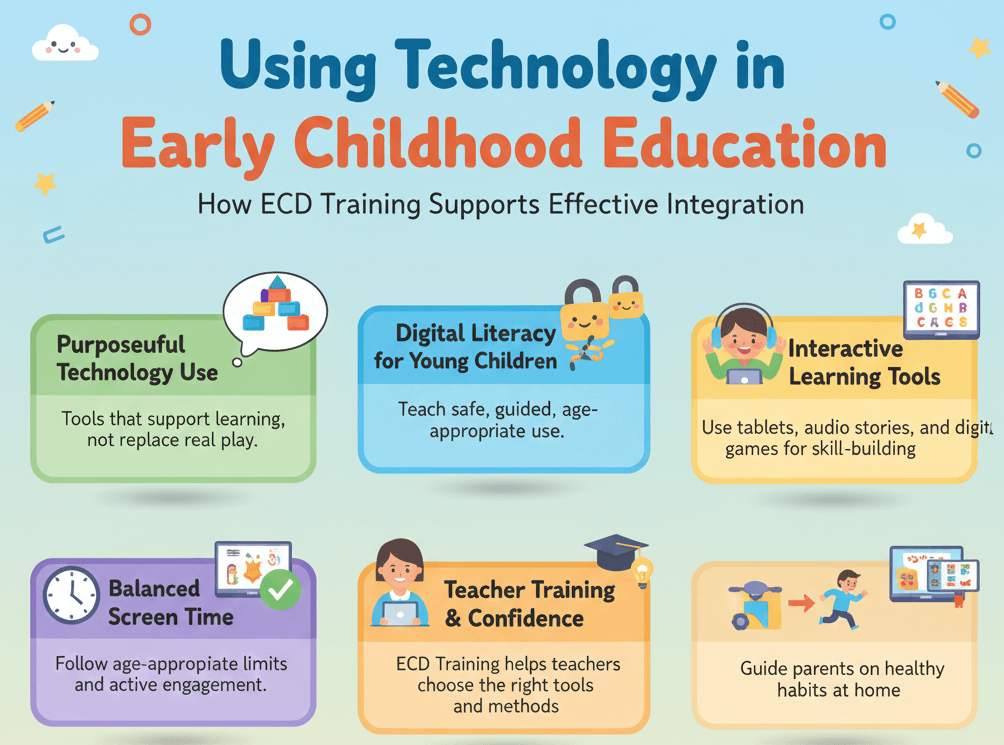
Benefits of Technology Integration in Early Childhood Education
Technology integration in ECE brings many potential benefits, especially when combined with thoughtful pedagogy and strong ECD training.
Enhancing engagement and motivation
When children use a tablet or interactive whiteboard they often become more engaged in the lesson. According to a survey, 90% of early childhood teachers had access to technology at school and 88% reported they used technical devices regularly. The interactive nature of digital tools can grab attention in ways that static materials might not.
For example, imagine a small group of three-year-olds using a tablet app to trace letters of the alphabet. They touch the letter, hear a sound, get encouragement, and can repeat if needed. This kind of technology integration supports literacy in a fun way.
Supporting multiple developmental domains
Technology integration can support children’s cognitive, language, and social-emotional development. A systematic review found that educational technology in early childhood education helped improve children’s interest in learning, language skills, arts, and cognitive outcomes. For instance, when children use interactive story apps, they listen, tap responses, talk about characters, and then do a craft activity tied to the story. This supports language, listening, creativity and fine-motor skills.
Another study showed that children using interactive devices recorded improved material comprehension compared to conventional methods.
Personalised and accessible learning
Technology integration offers us tools to tailor experiences to individual children’s pace and needs. For example, adaptive apps may adjust difficulty depending on how well a child is doing. One article noted over 70% of preschools used some kind of digital tool in the curriculum as of its publication. In ECE settings this supports children who might need extra help or children who are ready to move ahead.
Moreover, technology can support children with special educational needs. Assistive technologies-for example speech-to-text, visuals, digital storytelling-help inclusion and accessibility.
Enhancing family-school communication and administration
Technology integration isn’t just about children using apps. It also supports professional tasks and family engagement. For example, platforms can send photos and updates to parents, or make scheduling and record-keeping easier. Technology in ECE can improve administrative efficiency, support teacher professional development, and strengthen family engagement.As an ECD professional, you can leverage these systems so that families feel more connected to the child’s learning, and you spend less time on paperwork and more time with children.
Challenges of Integrating Technology in Early Childhood Education
Though the benefits are strong, good ECE practice requires that we also recognise the challenges around technology integration, and that ECD training helps professionals handle these.
Screen time and developmental impact
A very common concern is screen time. Especially in early years, children need hands-on play, social interaction, movement, and sensory experiences. Excessive technology use can reduce opportunities for these experiences. Research has identified several potential drawbacks, including reduced physical activity, limited social interaction, overstimulation, shorter attention spans, and sleep disruption. For example, if children spend too long on a tablet game instead of outdoor play, their physical development (gross motor skills, balance) may suffer.
Digital divide / access and equity
Not all children have access to equal technology or internet at home or in their centre. This creates a “digital divide” that risks widening educational disparities. As professionals in early childhood education, we must consider equity: ensuring children from lower-income families aren’t left behind when we adopt technology integration.
Privacy, security and content issues
When using devices and internet-connected tools, data privacy and content safety become important. Some tools may collect children’s data, and there is the risk of inappropriate content exposure. ECD training should include how to vet apps and platforms, how to ensure compliance with privacy standards, and how to supervise children’s use safely.
Professional training and change management
Technology integration only works if educators are prepared. Even the best tool fails if staff don’t know how to use it or resist it. Training is essential. Training and ongoing support are essential for successful technology integration in early childhood education. If you are an ECD trainer or practitioner, you will recognise that introducing technology is more than buying tablets – you must invest in training, scaffolding staff capacity, and ongoing reflection.
The Role of ECD Training in Supporting Effective Integration
In the context of early childhood development professionals, ECD training is central to ensuring technology integration is meaningful, age-appropriate, and aligned with long-term child development goals.
Building understanding of child development and technology
Good ECD training helps educators understand how young children develop – cognitively, socially, emotionally, physically – and how technology can support (or interfere) with these domains. For example, an ECD course might show how a tablet app can help fine motor skills, but also stress that finger tracing cannot replace tactile play with clay or blocks. Trainers can emphasize that technology integration must be developmentally appropriate, not just using devices because they are “new”.
Guiding selection of developmentally appropriate tools
ECD training programs should cover how to select technology tools that align with classroom goals and children’s needs. For example:
- Is the app interactive or passive?
- Does it support creativity, problem-solving, collaboration rather than just consume content?
- Is the tool suitable for the age group?
- Can children use it with supervision and scaffolded support?
Literature suggests technology must be adjusted to age, education level and targets of students. As an ECD professional, you would look for tools that promote active involvement-not just “watch this video”.
Developing strategies for integration in curriculum and context
ECD training should help practitioners plan how and when to use technology in the classroom. Some key strategies include:
- Defining clear objectives: e.g., use an interactive whiteboard for a collaborative literacy activity.
- Planning scaffolding: initial teacher-led demonstration, then children use the tool, then reflect.
- Balancing technology use with play, outdoor time, social interaction.
- Monitoring and evaluating: check children’s engagement, learning outcomes, screen time impact.
By embedding technology integration into the overall curriculum and not treating it as an add-on, educators ensure continuity and relevance.
Supporting ongoing professional development
Technology evolves: new tools, new platforms, new pedagogy. ECD training must not be a one-off. It should include ongoing professional development, peer collaboration, reflection on practices, and updates. It is important for educators to stay up to date with the latest tools and adjust their teaching practices as technology evolves. For you as an ECD professional, this means participating in workshops, sharing experiences with colleagues, and being open to experimentation.
Addressing ethical, equity and safety issues
In ECD training, it is vital to cover the ethical dimensions of technology integration: ensuring equal access for all children, protecting privacy, making sure screen time is appropriate, and preventing over-reliance. For example, you might learn to set screen-time limits, supervise children’s interaction with devices, select apps that don’t display ads or collect personal data, and involve families in discussions about technology use at home.
Best Practices for Integrating Technology in Early Childhood Education
Here are some practical tips and guidelines for ECD professionals to use when planning technology integration in early childhood settings.
1. Start with a clear vision and purpose
Ask: Why are we using technology? What learning outcomes do we want? The tool should serve the learning, not the other way around. Before purchasing new devices or software, it is important to clearly define the goals and reasons for adopting the technology.
For example, your goal might be: “Using a tablet app to support phonemic awareness for children aged 4–5, for 10 minutes twice a week, followed by group discussion and drawing activity.”
2. Choose developmentally appropriate tools
Ensure the tool is suitable for the children’s age, their developmental stage, their language ability. Use interactive apps that promote problem-solving, creativity, collaboration instead of passive watching. For example, choose an interactive whiteboard activity where children drag and sort shapes together rather than a simple video.
3. Provide scaffolded support and modelling
Children learn best when teachers model how to use the technology and provide supportive scaffolding. For example:
- Demonstrate how to open the app, how to respond to prompts.
- Work with a small group initially.
- Encourage peer collaboration: two children rotate roles (navigator, helper) when using the tablet.
- Use follow-up activities without the device: drawing, role-play, craft.
This scaffolding supports meaningful use and helps integrate technology into the broader learning environment.
4. Balance technology use with other experiences
Technology should complement, not replace, active play, social interaction, and physical movement.It is important to remember that technology should complement, not replace, children’s play, exploration, and social interaction.For example, after a digital app session on counting, children go outside to collect natural objects and count them in pairs.
5. Monitor use and reflect on outcomes
Keep track of how children engage with the technology: Are they focused? Are they enjoying it? Are they learning the intended outcomes? Are there signs of overstimulation or distraction? Adjust accordingly. The literature emphasises that without monitoring, the benefits of technology may be less than optimal.
6. Involve families and build home-school connection
Use technology to communicate with families: share what children did, send home suggestions for simple digital or non-digital activities, ask parents how children use tech at home. This strengthens the home-school link and helps ensure consistent, thoughtful technology use.
7. Ensure equity, access, and safe practices
Make sure all children have access regardless of background. Consider partnerships, funding, or scheduling device use to equalise access. Also ensure apps are age-appropriate, free from harmful content, protect children’s data, and screen-time limits are respected.
8. Provide ongoing professional development
As mentioned under the ECD training section, make sure staff receive regular training on new tools, new pedagogies, and share experiences. Reflective practice is key: what worked? What didn’t? How did children respond? What modifications are needed?
Practical Example: Applying Technology Integration in a Preschool Setting
Let’s illustrate how an ECD professional might apply these steps in a preschool classroom.
Setting: A preschool class of five-year-olds in an ECE centre.
Goal: Develop early literacy skills (letter recognition, phonemic awareness) and collaboration.
Plan:
- Choose a tablet app where children trace letters, hear sounds, and then create their own word. (Developmentally appropriate)
- Start with teacher modelling: show the class how to open the app, select the letter, trace, hear the sound.
- Children work in pairs: one child traces, the other watches and gives feedback. They switch roles.
- After 10 minutes with the tablet, the children move to a physical activity: they choose letter-cards, form small words using magnetic letters, in pairs, then share with the group.
- Educator monitors children’s engagement: Are they using the app independently? Do they require help? Are they collaborating well?
- At home: send a simple parent-friendly note via a digital platform: “Ask your child to find objects starting with the letter we used today. Spend 5 minutes together!”
- Reflect: After the session, the educator and colleagues meet to discuss: Did the children show increased interest? Did they trace letters faster? What adjustments are needed for next week?
- Ensure time limit: 10 minutes of tablet use, then at least 20 minutes of hands-on or outdoor play to balance screen time.
In this example, technology integration is intentional, limited in time, scaffolded, paired with hands-on play, and connected with families. The educator uses skills gained from ECD training to plan, execute and reflect.
Why ECD Professionals Should Care
As an ECD professional, caring about technology integration, early childhood education practices, and ECD training matters for several reasons:
- Young children’s early years set the foundation for lifelong learning. Integrating technology poorly could compromise opportunities for true engagement and development.
- Proper technology integration can help you meet diverse learners: children from varied backgrounds, children with special needs, children with different learning styles.
- As technology becomes more embedded in society, children who develop healthy, balanced, scaffolded tech-skills may be better prepared for the future.
- Your professionalism and training matter: being able to select, use and reflect on technology tools ensures that you maintain high-quality early childhood education.
- Families increasingly expect thoughtful use of technology. Using technology well (and being able to explain and reflect on it) can help build trust with families and stakeholders.
Finally, technology is not the goal-not the “shiny device” is the goal-but what children learn and how they grow. As an ECD professional, you ensure that technology serves learning, interaction, development, not just screen time.
Conclusion
In summary, technology integration in early childhood education offers many exciting opportunities: increased engagement, personalised learning, support for diverse learners, and improved family communication. However, technology also brings challenges: screen time concerns, access and equity issues, privacy and safety risks, and the need for thoughtful pedagogy. That is why strong ECD training is critical – it equips educators with the knowledge and skills to integrate technology responsibly, developmentally appropriately, and effectively.
For ECD professionals working in early childhood education, the goal is not simply to adopt devices, but to weave technology into the learning environment in a way that enhances, rather than replaces, play, social interaction, movement, creativity and human connection. By following best practices-setting clear goals, choosing appropriate tools, scaffolding use, balancing digital with non-digital experiences, involving families, ensuring equity, and reflecting regularly-you can ensure that technology integration supports children’s growth in meaningful ways.
I encourage you to take time to reflect on your current practice: How do you currently use technology in your setting? What is your vision for its use? Do you have access to ECD training focused on technology integration? Could you collaborate with peers to try new tools, reflect on outcomes, and keep learning? With commitment, technology integration in early childhood education can become a strong ally in supporting children’s holistic development.
Thank you for your dedication to early childhood education and for investing in children’s futures through thoughtful practice and professional development.
