
Each day brings a new and interesting moment in early childhood classrooms. A child may build a tower while another child sits near them without talking or joining. Suddenly, one child grabs a block, and a small conflict begins. These moments may seem normal, yet they show an important stage in toddler social development. Helping children move from playing alone to playing with peers requires thoughtful guidance. Cooperative play for toddlers becomes an essential skill during this period.
Every shared toy and every turn taken is a building block for confident, caring children.
Children aged 0–8 need opportunities to build social, emotional, and communication skills. Cooperative play supports teamwork, empathy, problem solving, and early relationship-building. Older children in preschool and early primary school also benefit as they learn to negotiate rules, share materials, and manage group activities. When teachers and caregivers use simple, consistent strategies, encouraging sharing in toddlers becomes easier and more natural.
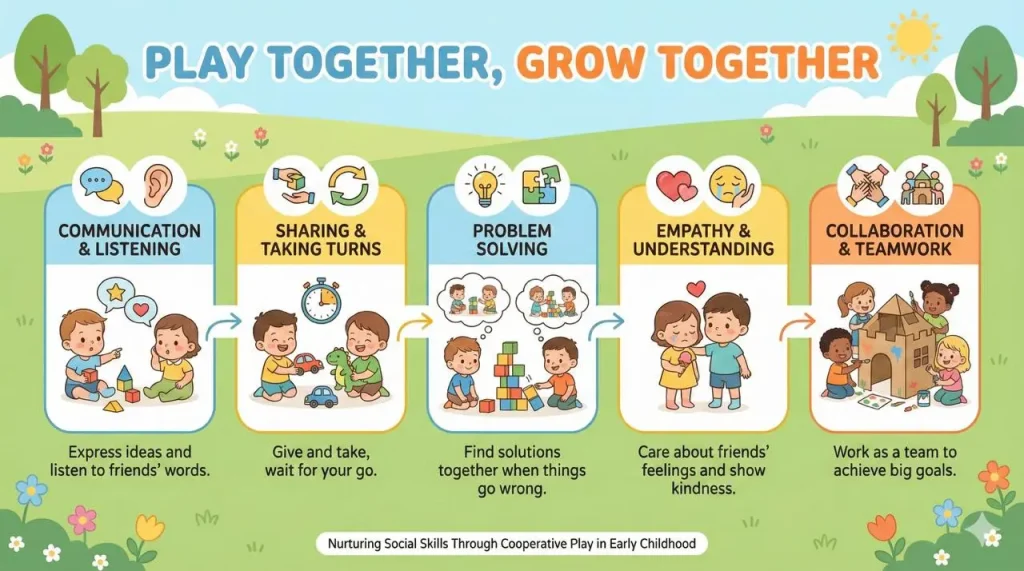
This article provides research-based, practical steps that teachers and caregivers can use daily. Each section includes real classroom examples, evidence, and clear tips for supporting cooperative play for toddlers in any early childhood setting.
Understanding Cooperative Play Stages
Before encouraging cooperative play for toddlers, it is important to understand how play develops. Research indicates that toddlers usually begin with “parallel play,” where they play next to peers without interacting. This is a normal part of toddler social development and prepares children for more interactive play.
In many classrooms, teachers observe toddlers watching a peer’s game, copying actions, or passing materials. These early signs show readiness for shared play. With gentle support, toddlers can move into cooperative play, where they share goals, take turns, and communicate with others.
Actionable Tips
- Observe first. Identify when toddlers show interest in each other’s play.
- Introduce simple group activities. Use games that allow children to join and leave easily.
- Model language. Use phrases like “Can I have one?” or “Let’s do it together.”
- Celebrate attempts. Praise cooperation even when it is brief or imperfect.
Setting Up the Environment for Cooperation
The environment plays a major role in cooperative play for toddlers. A well-planned space encourages children to interact, communicate, and explore shared activities. When the environment is inviting and calm, toddlers feel safe to join peers.
In many early childhood settings, teachers notice that crowded or overstimulating spaces lead to conflicts. Toddlers may grab toys or move quickly from one area to another. A thoughtful environment reduces frustration and supports toddler social development.
Actionable Tips
- Provide duplicate materials. Offer two or more identical toys to reduce conflicts during play.
- Create play zones. Use soft rugs, shelves, or mats to define shared spaces.
- Use open-ended toys. Blocks, sand, dolls, and kitchen items encourage group play.
- Ensure space for movement. Toddlers need room to shift positions while playing together.
Research indicates that well-designed play environments support stronger cooperation and reduce behaviour challenges.
Encouraging Sharing and Turn-Taking
Sharing is a major part of cooperative play for toddlers, but it is also one of the most challenging skills. Toddlers naturally think about their own needs first. They may struggle to wait, hand over toys, or negotiate with peers. Encouraging sharing in toddlers requires patience, modelling, and daily practice.
Cooperation begins with simple moments — a pause, a wait, a smile — repeated until they become habits of kindness.
Imagine two toddlers reaching for the same puzzle piece. One child pulls it quickly while the other cries. These moments give teachers a chance to guide cooperation and help toddlers understand fairness.
Actionable Tips
- Use simple sharing language. Try: “Your turn now, my turn next.”
- Introduce turn-taking props. Use a timer, a “sharing stone,” or a picture card.
- Offer choices. Ask: “Would you like the blue truck or the red truck?”
- Praise positive behaviour. Say: “You waited. That was kind.”
It is important to consider that toddlers need repeated experiences with sharing. Research indicates that consistent adult support helps toddlers develop self-control and cooperation.
Supporting Communication During Play
Clear communication helps toddlers express needs, solve problems, and participate in shared games. However, language skills are still developing at this age. Many toddlers communicate through gestures, pointing, or simple words. Teachers and caregivers play a key role in modelling communication that supports cooperative play for toddlers.
For example, a toddler may shout “Mine!” when a peer touches their toy. Instead of removing the toy, adults can introduce simple phrases that help toddlers communicate calmly.
Cooperative play turns small moments—like taking turns or helping a friend—into powerful lessons that shape a child’s social future.
Actionable Tips
- Model short sentences. Use phrases like “Let’s play together” or “Can I have it?”
- Use visual cues. Pictures of play rules help toddlers understand expectations.
- Encourage gesture communication. Teach simple signs for “wait,” “share,” and “help.”
- Stay close during early interactions. Gentle support helps children feel secure.
Research indicates that strong early communication skills support long-term social and emotional development.
Using Cooperative Activities to Build Social Skills
Cooperative activities offer structured opportunities for shared goals and teamwork. Teachers can use simple activities that encourage cooperation without overwhelming toddlers. These planned experiences help toddlers practise turn-taking, problem solving, and communication.
Observation shows that toddlers enjoy activities such as rolling a ball to a friend, building block towers together, or moving objects from one place to another as a group. These moments promote toddler social development naturally.
Toddlers don’t just play together—they learn how to share, communicate, and care.”
Actionable Tips
- Try group art. Provide a large paper sheet and encourage children to draw together.
- Use simple team games. Rolling a ball in a circle helps toddlers practise turn-taking.
- Plan cooperative clean-up. Ask children to collect blocks or toys as a team.
- Introduce matching tasks. Activities like sorting colours encourage shared focus.
Guiding Toddlers Through Conflict
Conflict is a natural part of cooperative play for toddlers. Toddlers are learning to manage emotions, share materials, and understand others’ feelings. Instead of avoiding conflict, adults can use it as a chance to teach positive social behaviours.
In many classrooms, toddlers become upset when someone takes a toy or interrupts their game. Teachers can support children by acknowledging emotions and offering simple tools to resolve problems.
Actionable Tips
- Stay calm and close. Toddlers need reassurance during conflict.
- Label emotions. Say: “You feel sad because you want the toy.”
- Suggest solutions. Offer ideas like “Let’s take turns” or “Find another piece.”
- Guide gentle touch. Show toddlers how to use soft hands with peers.
Research indicates that supportive adult guidance during conflict helps children build empathy and emotional regulation.
Modelling Cooperative Behaviour
Toddlers learn by watching adults. Teachers and caregivers who model respectful, calm, and cooperative behaviour show children how to behave with peers. Modelling becomes a simple but powerful way to encourage cooperative play for toddlers.
Observation shows that when adults use positive communication and teamwork, toddlers copy these behaviours during play. This supports toddler social development across the day.
Actionable Tips
- Model teamwork. Work with another adult and talk aloud while cooperating.
- Show respect. Use polite words such as “please,” “thank you,” and “excuse me.”
- Play with children. Join play briefly to show turn-taking or sharing.
- Demonstrate problem-solving. Say: “Let’s fix this together.”
Working with Families to Support Cooperation
Family involvement strengthens cooperative play for toddlers. When families use similar strategies at home, toddlers learn skills faster and with more confidence. Families can support encouraging sharing in toddlers through simple daily routines.
Teachers often see stronger cooperation in children whose families practise turn-taking games, shared responsibilities, and calm communication at home.
Actionable Tips
- Share simple home activities. Suggest rolling a ball, reading together, or doing small tasks as a team.
- Provide language tips. Give families phrases that support sharing and cooperation.
- Offer short communication updates. Highlight positive interactions at pick-up time.
- Encourage consistent routines. Similar expectations at home and school increase success.
Cooperative play is the first step toward teamwork, empathy, and lifelong friendships.
Conclusion
Cooperative play for toddlers is a key part of early social and emotional development. When toddlers learn to share, take turns, solve problems, and communicate with peers, they build strong foundations for future learning. Teachers and caregivers can support these skills by creating safe play environments, modelling cooperative behaviour, introducing structured activities, and guiding children through conflict. Families also play an important role by using similar strategies at home.
These small steps over time help toddlers develop confidence, empathy, and a sense of belonging. Each cooperative moment strengthens relationships and builds positive classroom communities.
Key Takeaways
- Create environments that encourage shared play.
- Model simple sharing and turn-taking language.
- Use cooperative games to support social development.
- Guide children gently through conflicts.
- Work closely with families to reinforce skills at home.
- Celebrate every attempt at cooperation.
- Provide repeated opportunities for practice.
With patient guidance and thoughtful routines, toddlers can develop strong social skills that support lifelong learning and friendships.
FAQs
Why is cooperative play important for toddlers?
Cooperative play for toddlers helps children build early social and emotional skills. It teaches them how to share, take turns, and communicate with peers. These skills support positive relationships and reduce behaviour problems. Research shows that early cooperative play strengthens later teamwork, emotional regulation, and problem solving. When toddlers learn to work with others, they feel more confident and secure in group settings.
What if toddlers refuse to share during play?
Sharing is difficult for toddlers because they are still learning self-control. Instead of forcing sharing, adults can model simple phrases such as “Your turn now, my turn next.” Offering duplicate toys and guiding children gently also helps. Over time, toddlers understand that sharing leads to positive interactions. Regular practice during daily routines supports encouraging sharing in toddlers naturally.
How can teachers reduce conflicts during toddler play?
Conflicts often happen because toddlers struggle with communication or impulse control. Adults can stay close, label emotions, and guide calm problem solving. Simple tools like timers or turn-taking cards help toddlers understand fairness. Creating a calm classroom environment with clear play zones also reduces stress. Consistent support helps toddlers learn how to manage conflicts respectfully.
How do toddlers learn cooperative behaviours?
Toddlers learn through observation, repetition, and modelling. When adults show cooperation, use respectful language, and solve problems calmly, toddlers copy these behaviours. Planned cooperative games also help children practise social skills. Over time, toddlers develop stronger communication, empathy, and teamwork abilities through repeated shared experiences.
How can families encourage cooperation at home?
Families can support cooperative play for toddlers by using simple daily routines. Rolling a ball back and forth, cleaning up toys together, or completing small tasks as a team all strengthen cooperation. Parents can model calm communication and offer simple choices to support sharing. When families use similar strategies as early childhood settings, toddlers learn skills faster and with more confidence.
References
- National Association for the Education of Young Children – Play Research
- Zero to Three – Toddler Social and Emotional Development
- Child Mind Institute – Teaching Children to Share
- Harvard Center on the Developing Child – Executive Function
